Blockchain technology is revolutionizing various industries, with its decentralized and secure nature offering unique opportunities. However, one of the fundamental pillars of this technology is the consensus mechanism. This process significantly contributes to upholding the integrity and security of the blockchain network.
What is a Consensus Mechanism?
A consensus mechanism is a set of rules or protocols that govern how participants in a decentralized network, often referred to as nodes, reach an agreement on the validity of transactions and the current state of a shared ledger, such as a blockchain.
In the absence of a central authority, these mechanisms ensure that all nodes collectively agree on the order and legitimacy of transactions, contributing to the security, integrity, and overall functionality of the network.
Consensus mechanisms play a crucial role in preventing fraud, maintaining the accuracy of the ledger, and enabling the decentralized nature of blockchain technology.
The History of Consensus Mechanisms
The concept of consensus mechanisms dates back to the early days of distributed computing, where researchers sought ways for multiple computers to agree on a single version of the truth without relying on a central authority.
This became particularly relevant with the emergence of blockchain technology, where a secure and decentralized ledger needed to be maintained without any single entity controlling it.
Here's a brief history of consensus mechanisms in blockchain:
Early Days (2008-2011):
- Proof of Work (PoW): Introduced in Bitcoin's whitepaper, PoW was the first and most widely used consensus mechanism. It utilizes computational power for solving complex puzzles, enabling nodes to engage in competition for the privilege to validate transactions and append new blocks to the blockchain.
- Byzantine Fault Tolerance (BFT): Developed for more complex systems, BFT tolerates Byzantine faults, where nodes can be malicious or fail in unexpected ways. It guarantees consensus even under such conditions but is computationally expensive and less scalable than PoW.
The Rise of Alternatives (2012-2015):
- Proof of Stake (PoS): Seeking to address PoW's energy consumption concerns, PoS was introduced as a more sustainable alternative. It allows users to stake their tokens to participate in the validation process, with the probability of validating a block proportional to the amount staked.
- Delegated Proof of Stake (DPoS): Designed for faster transaction processing, DPoS allows users to vote for delegates who validate transactions on their behalf. This reduces the computational burden on individual nodes and improves scalability.
Modern Developments (2016-Present):
- Hybrid Consensus Mechanisms: Combining different approaches, hybrid mechanisms aim to leverage the strengths of each individual approach. For example, Casper, Ethereum's upcoming consensus mechanism, combines PoW with PoS for a more secure and scalable network.
- Directed Acyclic Graphs (DAGs): DAG-based blockchains like IOTA and Hedera Hashgraph offer an alternative to the traditional chain structure, allowing for faster transaction processing and improved scalability.
Importance of a Consensus Mechanism:
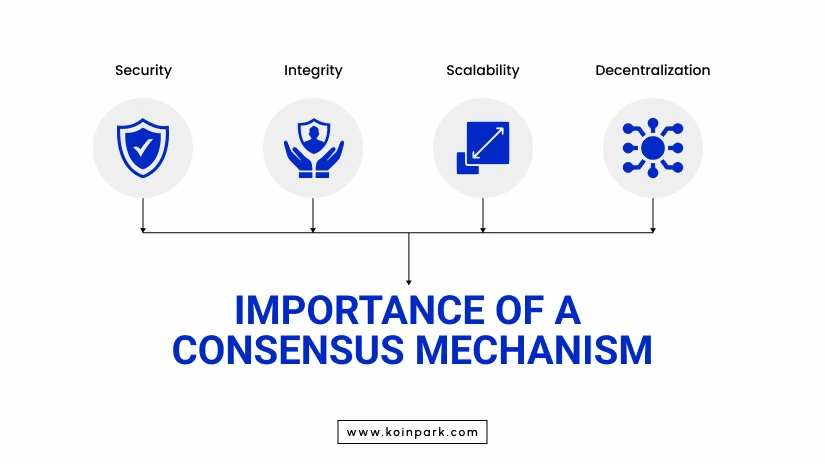
- Security: Prevents malicious actors from tampering with the blockchain or double-spending cryptocurrency.
- Integrity: Maintains the accuracy and consistency of the shared ledger.
- Scalability: Determines how efficiently the network can process transactions.
- Decentralization: Ensures that no single entity has control over the network.
Popular Consensus Mechanisms:
- Proof of Work (PoW): Utilizes computational power to solve complex puzzles and validate transactions. (Example: Bitcoin)
- Proof of Stake (PoS): Requires users to stake their tokens to participate in the validation process. (Example: Ethereum)
- Delegated Proof of Stake (DPoS): Users vote for delegates who then validate transactions. (Example: EOS)
- Byzantine Fault Tolerance (BFT): Ensures consensus even in the presence of malicious nodes. (Example: Hyperledger Fabric)
Future of Consensus Mechanisms:
As blockchain technology continues to evolve, new and innovative consensus mechanisms are emerging. These mechanisms aim to address the limitations of existing approaches and offer improved performance in terms of efficiency, security, and scalability.
Bottom Line
The consensus mechanism is the backbone of any blockchain network. By understanding the different types of mechanisms and their implications, users can make informed decisions about which blockchain technology is best suited for their needs. The future of blockchain technology will undoubtedly be shaped by the continued development and adoption of efficient and secure consensus mechanisms.
This blog is just a starting point for understanding blockchain consensus mechanisms. If you'd like to learn more about specific mechanisms or the latest developments in this field, keep an eye out on Koinpark, the best cryptocurrency exchange in India. Happy learning!